
At a solar power plant, dust, dirt and mineral deposits building up on the panel surface can cause an output loss of between 5% and 25%, depending on the region and conditions. The way to recover that loss is regular panel washing. But one detail is often overlooked in the field: the quality of the water used for washing matters as much as the washing itself.
Where does the loss come from?
Every layer on the panel surface reduces the light reaching the cell. The source of soiling depends on where the plant is: wind-blown dust in arid regions, pollen and spray residue near farmland, fine particles at sites close to roads and industrial zones, and bird droppings everywhere.
That is also why the loss spans such a wide range. In a region with regular rainfall and relatively clean air, the loss stays close to the lower limit; at sites with little rain, heavy dust and irregular washing, it can approach the upper limit. The tilt angle of the panels and the washing frequency also have a direct effect.
5–25%: Output loss on soiled or mineral-stained panels, varying with region and conditions.
Washing recovers the loss. But with what water?
Panels in the field are usually washed with whatever water is easiest to get: well water, mains water or water brought in by tanker. What these waters have in common is that they contain dissolved minerals, above all the calcium (Ca) and magnesium (Mg) ions that cause water hardness.
When a panel is washed with hard water, the minerals stay on the surface as the water evaporates. The first wash leaves a thin film; repeated washes build it up into a layer of scale. This film is hard to see, but it keeps reducing light transmission.
2–4%: The additional efficiency loss that a thin mineral film left after washing can cause.
In other words, washing with the wrong water is the most expensive option after not washing at all. The water, labour and time spent on washing do not fully pay off, and removing the accumulated scale calls for harder brushing, which increases the risk of wearing down the surface coating on the panel glass.
Clean panels need pure water
Solar panels washed with tap water look clean at first glance. But once the water dries, the mineral residue left on the surface stops part of the light before it reaches the cell. The result is invisible to the eye, but it shows up on the bill.
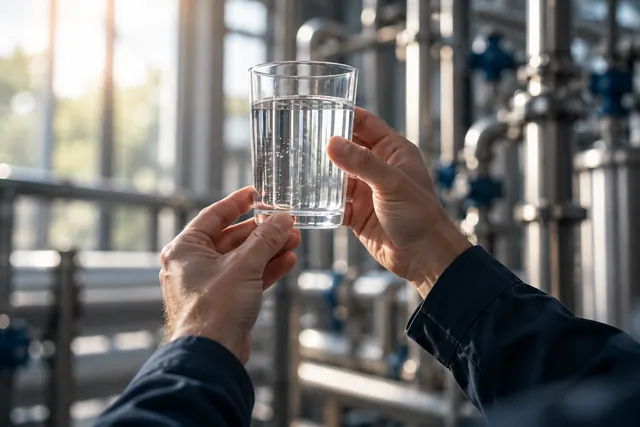
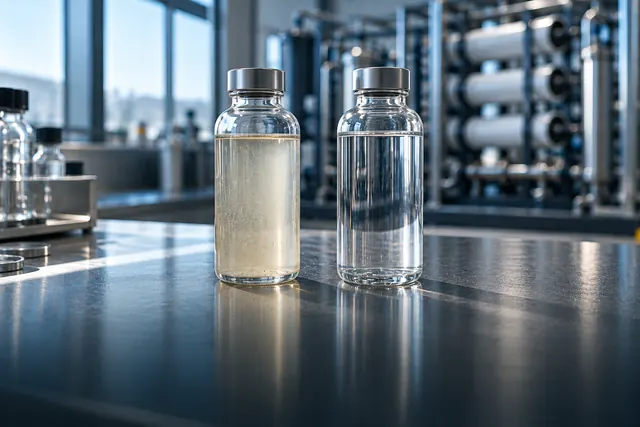
The problem is not the washing but the quality of the water. Washing with hard mains water or groundwater removes the dust from the surface but leaves a thin film of minerals behind. The solution is not to wash more often but to change the quality of the water used. Demineralised or RO-treated water leaves no marks as it dries: the panel becomes clean optically, not just visually.
Using low-conductivity water for panel washing is also recommended: it helps prevent electrical accidents during washing and protects the panels against electrical faults.
The right washing water: water that leaves no marks
For panel washing, the goal is water with a mineral content low enough to leave no residue on the surface when it evaporates. This is measured as TDS (total dissolved solids). The TDS value, hardness and other constituents of your source water determine how much treatment the water needs and which methods to use. That is why the first step is always a water analysis.
Depending on the analysis results, the main treatment stages are:
- Sand, activated carbon and fine sediment filtration: Removes suspended solids, turbidity, organic matter and particles. It acts as pretreatment, protects the stages that follow and extends membrane life.
- Iron and manganese filtration: Removes iron and manganese from the water through oxidation and filtration, reducing the risk of coloured stains common with well water.
- Softening: Removes the calcium and magnesium that cause hardness by ion exchange and reduces scale formation. It does not, however, lower total dissolved solids, so on its own it may not deliver mark-free water.
- Reverse osmosis (RO): Treats water to 90–99%, producing low-concentration water close to pure water. This is the decisive stage for mark-free rinse water in panel washing.
Not every plant needs the same combination. At a site using mains water, filtration and reverse osmosis may be enough, whereas well water with high hardness and iron content calls for more extensive pretreatment.
The right size for the plant
When designing a washing water system, it is not only the water quality that counts but also the operating realities of the plant:
- Washing volume and frequency: The size of the plant, the number of panels and the washing schedule determine the daily water demand.
- Source flow rate: The amount of water the well or mains connection can supply determines the storage requirement.
- Site conditions: Space, access to power and transport determine whether a fixed unit or a containerised package solution is installed.
- Concentrate management: The mineral-rich water separated by the reverse osmosis system is also part of the design and needs to be planned.
An oversized system is an idle investment; an undersized one falls short during the busiest part of the washing schedule. The right size means the right budget.
Recovering the washing water
The second issue is consumption. At a large solar plant, washing involves serious volumes of water. Drawing it from the mains is sustainable neither in terms of cost nor resources.
Treating the wastewater and returning it to the process changes this equation. In an MBR + RO system designed for an 80% recovery target, 8 out of every 10 m³ of water go back into use. Less dependence on the mains, lower discharge costs and more predictable operating expenses.
This is not just an environmental choice; it is a financial decision.
Practical notes from the field
Scheduling washing for the cooler hours of the day, early morning or late afternoon, reduces rapid evaporation and thermal stress on the hot panel surface. Setting the washing frequency according to the losses seen in production monitoring data, rather than a fixed calendar, makes better use of both water and labour. The panel manufacturer's instructions should always be followed for the cleaning method.
Every drop counts
Solar power plants are often built in regions where water is scarce and expensive. That makes panel washing both an efficiency issue and a water economy issue. Washing with properly treated water recovers lost output, and every litre of water used pays for itself.
Water analysis and preliminary feasibility meeting
We start by analysing your well or mains water. Based on your plant's washing volume and site conditions, we design right-sized filtration, softening and reverse osmosis stages, manufacture them at our facility in Çorlu, install them on site and commission them. Let's calculate your plant's recovery potential together: request a free water analysis or contact us: +90 212 428 00 85 · WhatsApp: +90 543 529 27 88.
Source: Output loss and efficiency drop figures are based on Energy Solutions, “Solar Panel Cleaning & Soiling Loss Data”. Figures vary with the plant's location, climate conditions and operating practices.